QUICK OVERVIEW
Key Takeaways
- Evaluate banquet chairs according to guest comfort, daily handling and venue operations—not appearance alone.
- Compare the complete chair structure, including the frame, seat, backrest, upholstery and protective components.
- Review chair weight, stacking geometry and trolley compatibility as one coordinated transport system.
- Select upholstery and finishes according to cleaning, maintenance and long-term replacement requirements.
- Test representative samples with the venue’s tables, storage routes and operational team before placing a large order.
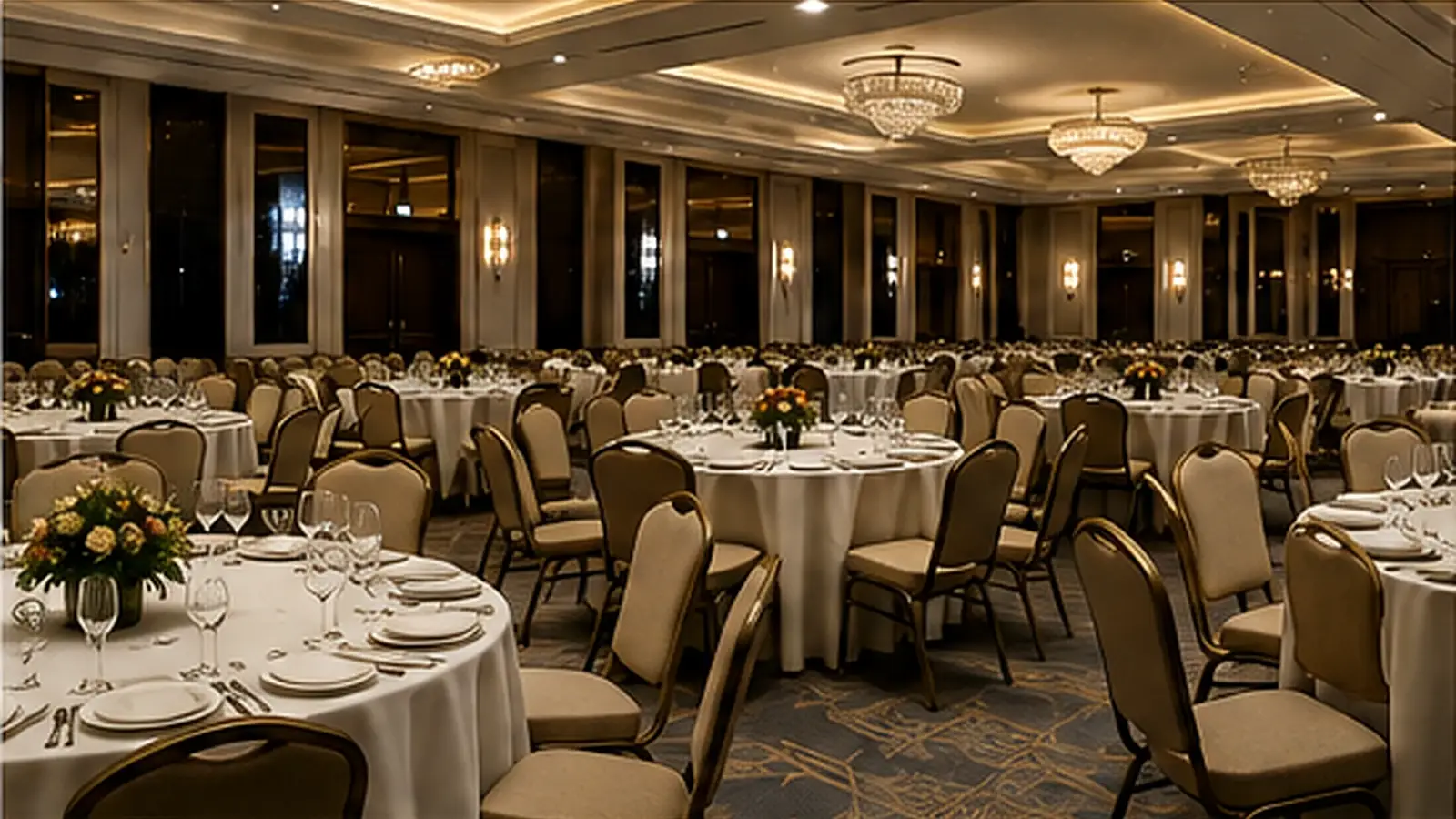
Professional banquet chairs must combine guest comfort, visual consistency, daily handling efficiency and space-conscious storage. Although appearance is important, a chair used in a hotel ballroom or event venue must also perform reliably through repeated setup, stacking, transport, cleaning and reconfiguration.
Small differences in chair weight, frame geometry, upholstery or stacking capacity can have a significant operational effect when hundreds of chairs are moved for different events.
This guide explains how hospitality professionals can compare banquet chair frames, seating comfort, upholstery, protective components, stacking systems, transport trolleys and storage requirements before making a purchasing decision.
For a broader introduction to event furniture planning, review our guide to choosing professional banquet equipment for hotels and event venues.
Why Banquet Chair Selection Matters
Banquet chairs influence more than the visual appearance of an event room.
They affect:
- Guest comfort
- Room capacity
- Table spacing
- Setup and breakdown time
- Staff workload
- Storage efficiency
- Transport safety
- Cleaning and maintenance
- Long-term replacement planning
- Consistency across different event spaces
A chair that looks appropriate in a furnished ballroom may become difficult to manage when it must be stacked, moved through service corridors and stored after every event.
The correct chair should therefore be evaluated in both its guest-facing and operational environments.
Begin with the Venue and Event Programme
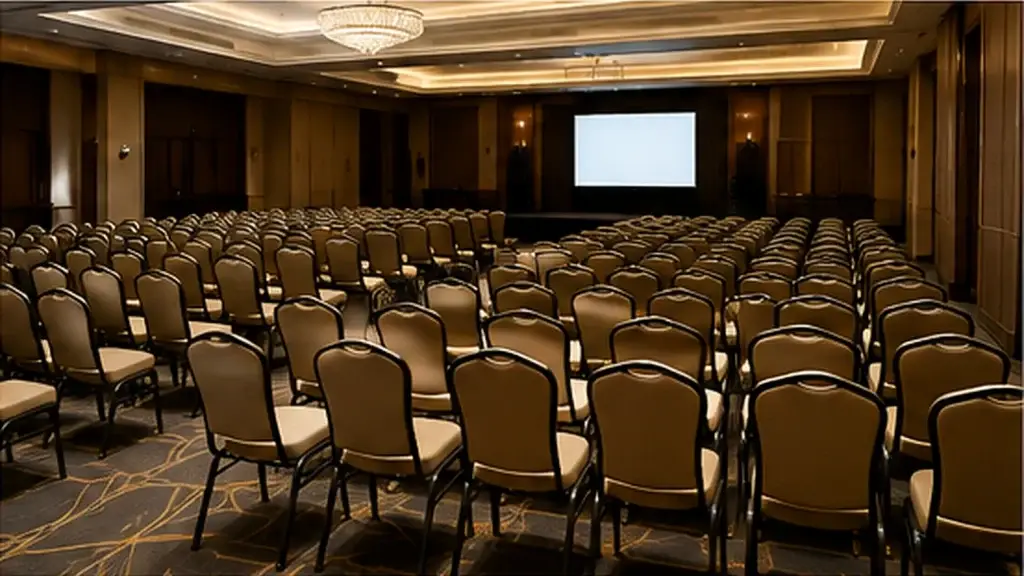
Before comparing chair models, define how the venue operates.
Important questions include:
- What types of events will be hosted?
- How long will guests normally remain seated?
- How frequently will the room layout change?
- How many chairs will be moved at one time?
- How many employees are available for setup?
- Will chairs move between different floors?
- What storage area is available?
- Which banquet tables will be used?
- Are chair covers planned?
- Are custom finishes or fabrics required?
A conference venue hosting full-day meetings may place greater emphasis on prolonged seating comfort. A ballroom hosting frequent weddings may prioritise visual consistency, upholstery options and rapid room transformation.
Many professional venues require one chair model to support dining, meetings, ceremonies and presentations. The selected design must therefore provide an appropriate balance between comfort, appearance and operational flexibility.
Evaluate Guest Comfort
Comfort should be considered according to the intended event duration and guest profile.
A chair may be occupied for several hours during:
- Conferences
- Gala dinners
- Weddings
- Award ceremonies
- Training sessions
- Presentations
- Formal meetings
Comfort depends on the complete relationship between the seat, backrest, upholstery and frame.
Seat Dimensions
Review:
- Seat width
- Seat depth
- Front edge shape
- Height from the floor
- Available space between arm and frame components
- Relationship with the banquet table
A seat that is too narrow may feel restrictive, while excessive depth may reduce back support for some users.
The chair should also fit comfortably around the selected tables without reducing guest capacity or creating difficult spacing.
Backrest Design
The backrest influences posture, comfort and the visual character of the chair.
Consider:
- Backrest height
- Shape
- Support position
- Upholstered area
- Frame contact points
- Decorative openings or panels
- Cleaning access
A visually distinctive backrest may support the interior concept, but it should not create difficult cleaning areas or interfere with stacking.
Foam and Cushioning
Seat comfort is influenced by:
- Foam thickness
- Foam density
- Cushion shape
- Upholstery tension
- Support beneath the foam
- Behaviour after repeated use
Comfort should be assessed using a finished sample rather than relying only on technical descriptions.
Where possible, ask several members of the project or operations team to evaluate the chair during a realistic seating period.
Compare Steel and Aluminium Chair Frames
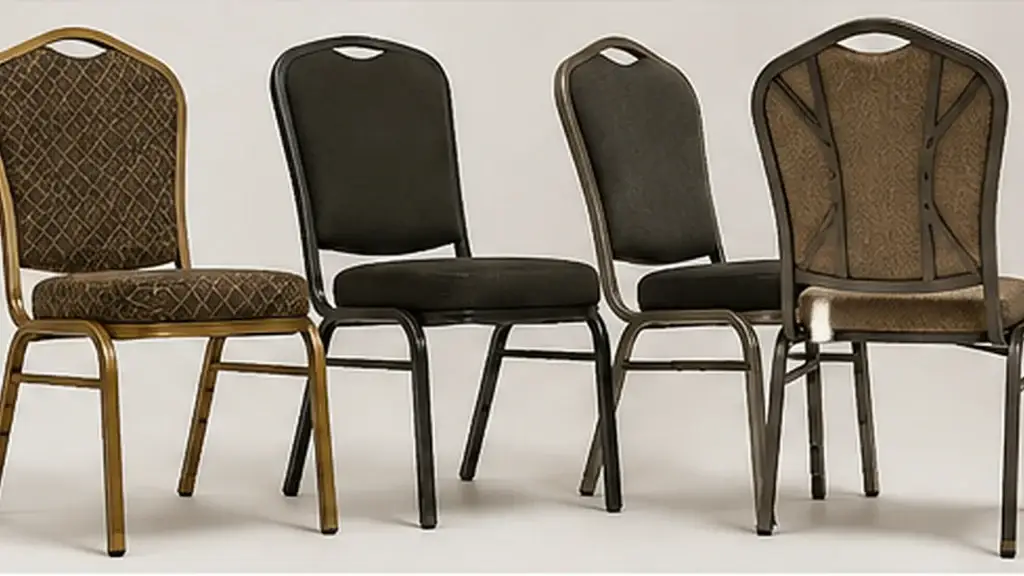
Steel and aluminium frames can both be appropriate for professional banquet chairs when correctly designed for their intended application.
The decision should not be based on frame material alone.
Evaluate:
- Complete chair weight
- Frame dimensions
- Construction method
- Surface finish
- Required appearance
- Handling frequency
- Maintenance expectations
- Project budget
- Trolley compatibility
- Storage arrangement
Steel Frames
Steel frames may offer a substantial appearance and can support a wide variety of decorative profiles and finishes.
Points to review include:
- Complete product weight
- Surface coating
- Weld quality
- Frame geometry
- Protection at contact points
- Maintenance requirements
Aluminium Frames
Aluminium frames may be considered where reduced handling weight and specific finish options are priorities.
Review:
- Frame wall construction
- Joint quality
- Surface treatment
- Resistance to repeated handling
- Compatibility with stacking components
- Overall chair stability
Neither material should automatically be described as better. The most appropriate choice depends on the complete design, construction quality and operational requirements.
Review Frame Construction and Stability
The chair should remain stable during normal professional use.
Stability may be influenced by:
- Frame geometry
- Leg position
- Connection points
- Seat support
- Backrest construction
- Floor contact points
- Product dimensions
- Weight distribution
Inspect the chair on different floor surfaces where possible.
A ballroom may include:
- Carpet
- Stone
- Timber
- Vinyl
- Temporary event flooring
- Stages or platforms
The chair should remain stable without causing unnecessary damage to the floor.
Joints and Connection Points
Review visible and concealed connection areas.
Look for:
- Consistent alignment
- Clean finishing
- Secure joints
- Protected contact points
- Absence of sharp edges
- Uniformity across sample chairs
For large projects, manufacturing consistency is as important as the quality of one individual sample.
Select Upholstery for Professional Use
Upholstery contributes to comfort, appearance, cleaning and long-term maintenance.
Possible options may include:
- Woven fabrics
- Performance fabrics
- Vinyl-type surfaces
- Custom textiles
- Customer-supplied materials
The selected material should be evaluated according to the actual venue environment.
Appearance and Interior Compatibility
Consider:
- Colour
- Texture
- Pattern
- Light reflection
- Compatibility with carpets and walls
- Relationship with table linen
- Consistency under different lighting conditions
Request physical samples when colour accuracy is important. Digital screens and printed documents may not accurately represent the final fabric.
Cleaning and Maintenance
Review:
- Recommended cleaning method
- Resistance to routine spills
- Surface texture
- Seam positions
- Accessibility around the frame
- Replacement possibilities
- Availability of matching material
A complex fabric may create an attractive visual effect but require more intensive maintenance.
Upholstery Replacement
For long-term projects, determine whether:
- Seats can be removed
- Back panels can be accessed
- Upholstery can be replaced
- Matching fabric can be supplied later
- Replacement parts are available
Repairability may extend the useful life of the chair and help the venue maintain a consistent appearance.
Understand Stackability
Stackability is one of the most important operational characteristics of a banquet chair.
However, the maximum number of chairs in a stack should not be considered alone.
A professional review should include:
- How smoothly chairs nest
- Whether frames contact upholstery
- Whether protective components are included
- Stack stability
- Loaded trolley height
- Visibility for the employee moving the trolley
- Door and lift clearance
- Storage ceiling height
- Ease of loading and unloading
Stacking Geometry
The frame should guide chairs into a consistent position.
Poor stacking geometry may lead to:
- Unstable stacks
- Frame scratches
- Upholstery damage
- Increased storage space
- Difficult trolley loading
- Slower setup procedures
Test several chairs together rather than examining only one unit.
Stack Protection
Protective components may be used to reduce direct contact between chairs.
Review:
- Position of stacking buffers
- Attachment security
- Replaceability
- Contact with the frame
- Contact with upholstery
- Behaviour during transport
Protective elements should remain effective after repeated use.
Consider Chair Weight and Staff Handling
A small difference in individual chair weight can become significant when large quantities are moved repeatedly.
The selected chair should provide an appropriate balance between:
- Manageable handling
- Structural stability
- Guest comfort
- Durability
- Visual quality
Do not evaluate weight only by lifting one chair.
Observe or simulate:
- Removing chairs from storage
- Loading or unloading a trolley
- Carrying individual chairs
- Positioning chairs around tables
- Restacking chairs after an event
- Moving the loaded trolley back to storage
The complete process provides a more realistic assessment of staff workload.
Grip and Handling Points
Employees should be able to handle chairs without:
- Pulling the upholstery
- Gripping decorative elements
- Trapping fingers
- Damaging frame finishes
- Using unstable lifting positions
Frame and backrest design should provide practical handling points.
Match Chairs with Banquet Tables
Banquet chairs and tables should always be evaluated together.
The relationship affects:
- Guest capacity
- Legroom
- Seat height
- Table height
- Chair spacing
- Room layout
- Service routes
- Overall appearance
A wider chair may improve comfort but reduce the number of guests around a table. A chair with a deep backrest may require additional circulation space.
Use the actual or intended table model when testing chair placement.
For detailed table selection criteria, refer to the Banquet Table Buying Guide.
Table Linen and Chair Interaction
Where full-length table linen is used, confirm that:
- Chair frames do not repeatedly catch the fabric
- Guests can move chairs without pulling the linen
- Decorative frame elements remain practical
- Chair placement does not interfere with table settings
Plan Chair Trolleys from the Beginning
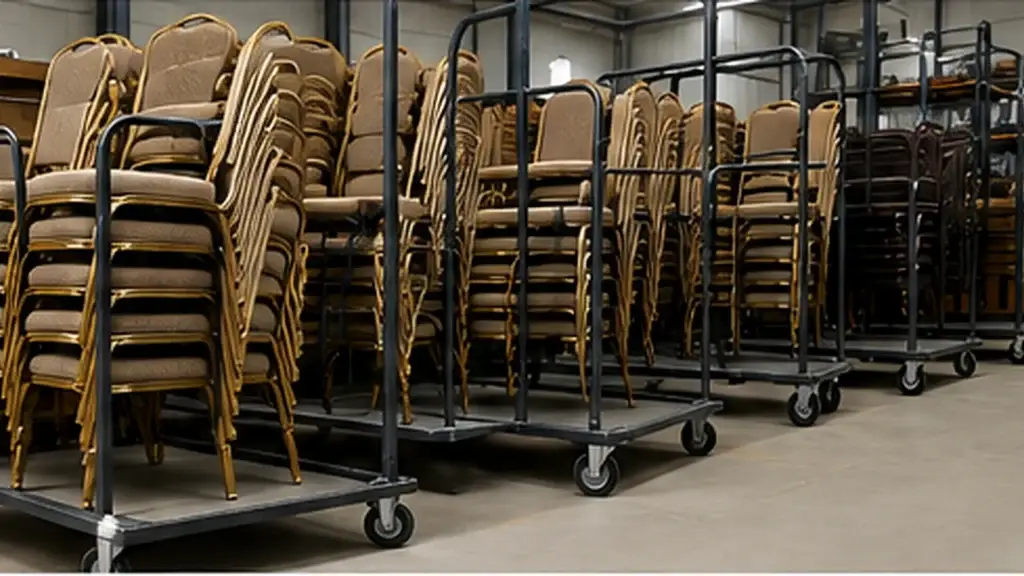
Chair transport trolleys should not be ordered as an afterthought.
A compatible trolley supports:
- Organised storage
- Faster setup
- Reduced manual carrying
- Safer movement
- Protection during transport
- Consistent staff procedures
Evaluate:
- Intended chair model
- Number of chairs carried
- Loading direction
- Loaded height
- Loaded width
- Handle position
- Wheel size
- Wheel material
- Brake system
- Turning radius
- Parking stability
A trolley designed to carry the highest possible number of chairs may become difficult to manoeuvre through narrow routes.
The appropriate trolley capacity depends on the building and operation.
Review the Complete Transport Route
Measure the route between the storage area and event rooms.
Include:
- Storage doors
- Service corridors
- Lift doors
- Lift interiors
- Loading areas
- Corridor turns
- Floor transitions
- Ramps
- Ballroom entrances
The narrowest point determines whether the loaded trolley can move efficiently.
Also consider:
- Floor protection
- Wall protection
- Staff visibility
- Shared service routes
- Movement during active hotel operations
The trolley should remain manageable even when corridors are partially occupied.
Calculate Storage Requirements
Storage planning should use actual loaded stack dimensions.
Consider:
- Stack width
- Stack depth
- Stack height
- Trolley footprint
- Handle projections
- Movement space
- Turning space
- Access between rows
- Ceiling restrictions
- Fire and building service clearances
A high chair stack may reduce floor usage but create other operational difficulties.
The venue should balance:
- Storage density
- Employee visibility
- Stack stability
- Safe loading
- Ceiling height
- Trolley manoeuvrability
Storage Organisation
Group chairs according to:
- Event room
- Chair model
- Finish
- Upholstery colour
- Frequency of use
- Trolley type
Frequently used chairs should remain accessible without moving less frequently used equipment first.
Clear labelling can support more consistent operations in properties with several event spaces or chair finishes.
Protect Floors, Frames and Upholstery
Banquet chairs repeatedly contact:
- Floors
- Other chairs
- Trolleys
- Walls
- Tables
- Storage equipment
Review protective components such as:
- Floor glides
- Stacking buffers
- Frame protectors
- Trolley supports
- Upholstery contact protection
Floor Glides
Floor glides should suit the flooring materials used throughout the venue.
Consider:
- Noise
- Movement resistance
- Replaceability
- Attachment method
- Compatibility with carpet
- Compatibility with hard floors
A glide that works well on carpet may behave differently on stone or timber flooring.
Replaceable Components
Frequently contacted protective parts should ideally be replaceable.
Ask whether items such as glides and stacking buffers can be supplied separately for future maintenance.
Review Finishes and Customisation
Banquet chair customisation may include:
- Frame colour
- Metal finish
- Upholstery fabric
- Seat and back design
- Decorative profiles
- Stitching
- Branding
- Removable covers
- Protective components
Customisation should be coordinated with:
- Project quantity
- Production programme
- Interior design
- Maintenance requirements
- Replacement planning
- Future expansion
Highly specific colours or fabrics may be difficult to match years later.
Keep approved material references and physical samples for future purchasing and refurbishment.
Test a Representative Sample
For a significant order, evaluate a representative sample before final approval where possible.
The sample review should include:
- Visual appearance
- Seat comfort
- Backrest comfort
- Frame stability
- Product weight
- Upholstery quality
- Finish consistency
- Stackability
- Trolley compatibility
- Table compatibility
- Cleaning access
Do not review the sample only in an office or showroom.
Where practical, test it in the actual ballroom, meeting room, storage route and service lift.
Ask representatives from different teams to participate:
- Operations
- Housekeeping
- Banquet setup
- Food and beverage
- Purchasing
- Interior design
- Management
Each team may identify different practical requirements.
Compare Complete Quotations
Two banquet chair quotations may appear similar while including different specifications.
Compare:
- Frame material
- Frame construction
- Finish
- Seat and back structure
- Foam
- Upholstery
- Protective components
- Chair weight
- Stackability
- Trolley inclusion
- Packing
- Customisation
- Delivery scope
- Replacement parts
Use a common specification sheet when requesting quotations from multiple suppliers.
Do not compare only the final unit price.
Common Banquet Chair Purchasing Mistakes
Selecting Chairs by Appearance Alone
The chair must also support repeated handling, stacking, transport, cleaning and storage.
Ignoring Chair Weight
Individual chair weight becomes operationally important when large quantities are moved frequently.
Evaluating Only One Chair
Stacking performance and transport requirements cannot be assessed from one chair alone.
Ordering Trolleys Later
Trolleys should be specified with the chair model and tested against the building route.
Ignoring Table Compatibility
Chair width, depth and seat height directly affect table capacity and guest comfort.
Choosing Fabric Without a Cleaning Review
The selected textile should suit the property’s maintenance procedures and expected usage.
Maximising Stack Height
The tallest possible stack may not be the safest or easiest arrangement for staff.
Failing to Plan Replacement Parts
Glides, buffers and upholstery components may require replacement during long-term use.
Banquet Chair Specification Checklist
Use the following checklist when preparing a project enquiry.
Venue Information
- Venue type
- Number of event spaces
- Maximum guest capacity
- Typical event formats
- Floor materials
- Storage room dimensions
- Door and lift measurements
- Delivery destination
Chair Requirements
- Required quantity
- Preferred frame material
- Frame finish
- Seat dimensions
- Backrest design
- Upholstery type
- Fabric colour
- Stacking requirements
- Target handling weight
- Protective components
- Branding or customisation
Operational Requirements
- Setup frequency
- Available setup staff
- Storage method
- Trolley capacity
- Movement route
- Floor protection
- Cleaning method
- Maintenance expectations
Compatibility Requirements
- Banquet table models
- Table dimensions
- Required seating capacity
- Chair cover use
- Trolley dimensions
- Lift and corridor limitations
Project Requirements
- Target delivery date
- Packing requirements
- Project location
- Sample approval
- Material references
- Company information
- Contact person
Clear project information allows the manufacturer to prepare a more accurate proposal.
Frequently Asked Questions
Which frame material is best for banquet chairs?
There is no universal answer. Steel and aluminium can both be suitable depending on the complete construction, product weight, finish, handling frequency and project requirements.
How should banquet chair comfort be evaluated?
Assess the seat dimensions, foam, backrest support, upholstery and intended seating duration using a finished sample.
How many chairs should be stacked together?
The appropriate stack quantity depends on the chair design, trolley, stack stability, storage height and transport route. Follow the manufacturer’s recommended system.
Should banquet chairs and trolleys be ordered together?
Yes. Chair geometry and trolley design should be evaluated as one transport and storage system.
What should be checked when choosing upholstery?
Review appearance, cleaning requirements, resistance to routine use, replacement options and compatibility with the venue’s interior.
How do banquet chairs affect room capacity?
Chair width, depth and spacing influence the number of guests that can be seated around each table and the circulation space required.
Can banquet chair finishes be customised?
Frame finishes, upholstery and selected design details may be customised according to project quantity and technical feasibility.
Select Chairs as Part of a Complete System
Professional banquet chairs should not be selected as isolated furniture products.
Their performance depends on how well they work with:
- Banquet tables
- Room layouts
- Guest capacity
- Transport trolleys
- Storage areas
- Setup procedures
- Cleaning systems
- Venue interiors
A coordinated selection helps create a consistent guest experience while improving handling, storage and long-term operational efficiency.
Explore Otelsan’s Banquet & Meeting Equipment collection for professional banquet furniture and transport solutions, or review the complete Product Catalogue for additional hospitality equipment.
For project-based guidance, share your required quantities, preferred finishes, upholstery expectations, storage conditions and delivery destination with the Otelsan team.